
How to assemble your Box-Kat mouse barrier
The Box-Kat mouse barrier is designed to go together simply and securely, and to stay in place for the season. Watch Tom assemble a kit from the box to a closed barrier, then follow along at your own pace.
Box-Kat Assembly Tutorial, 2:44


What's in the box
Open the box and lift out the first white panel; the rest come with it. Underneath you'll find everything else the kit needs.
- White panels
- Black flex connectors
- Large L-shaped braces
- Small braces
- Bag of fender clips, with spares
- One set of wing-nut screws
How to set up your Box-Kat for outdoor use
The Box-Kat is made for outdoor use, but a strong outdoor setup starts with good preparation. Uneven ground, loose gravel, and changing weather can all affect how the barrier sits, so taking a little extra time to prep the area and secure the braces can help your Box-Kat stay stable and work more effectively.
Gravel Setup, 1:21
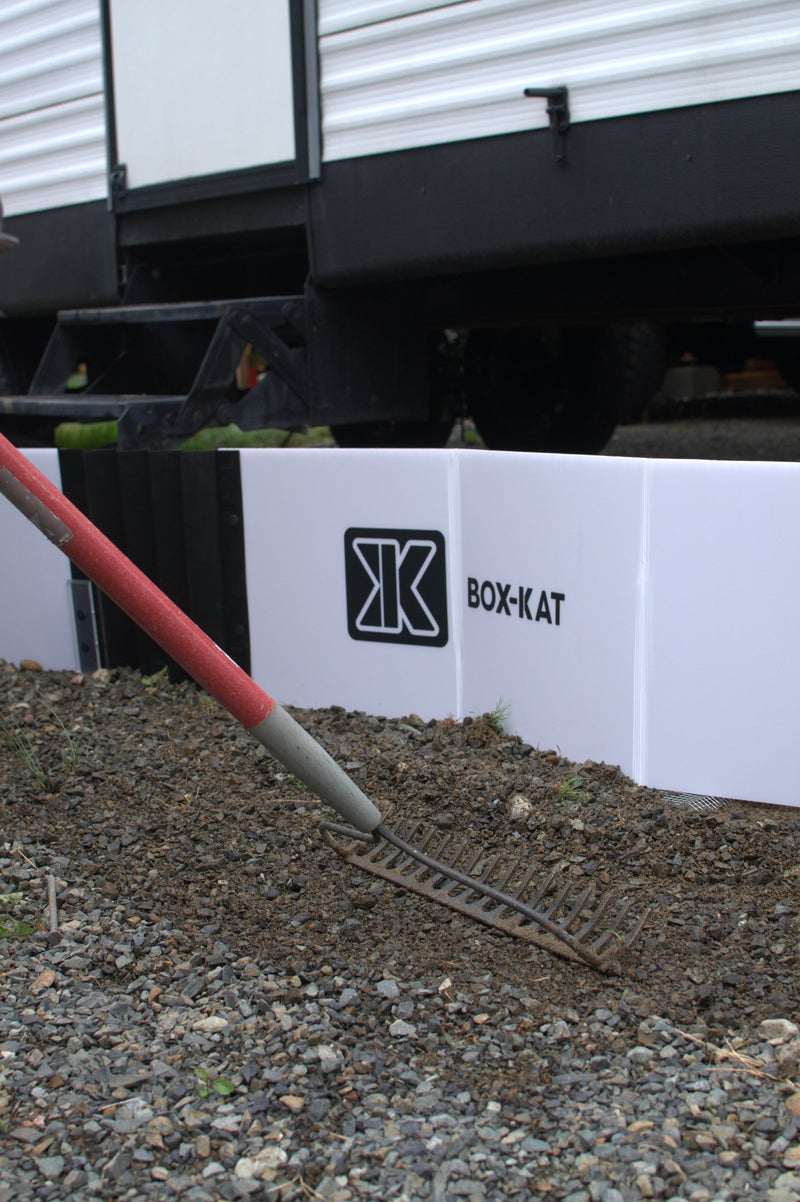
“You want to get your gravel down to hard pan as much as possible, so it's less likely to be burrowed under. And after you're done, rake a little gravel over it. Not a lot. You don't want to give them a leg up.”Tom Sharp, Box-Kat inventor
Prepare the surface
The Box-Kat's flex connectors help the barrier adjust to slight changes in slope, but the best results come when you make the parking area as smooth and gradual as possible first. If you're setting up on gravel or dirt, rake the area to remove large clumps, deep dips, and sudden changes in height. Your goal does not need to be a perfectly flat surface, just a more even one. Once the area is prepared, place the black flex connectors over the largest changes in slope so they can do their job of following the ground and helping reduce gaps.
Add galvanized mesh on gravel or dirt
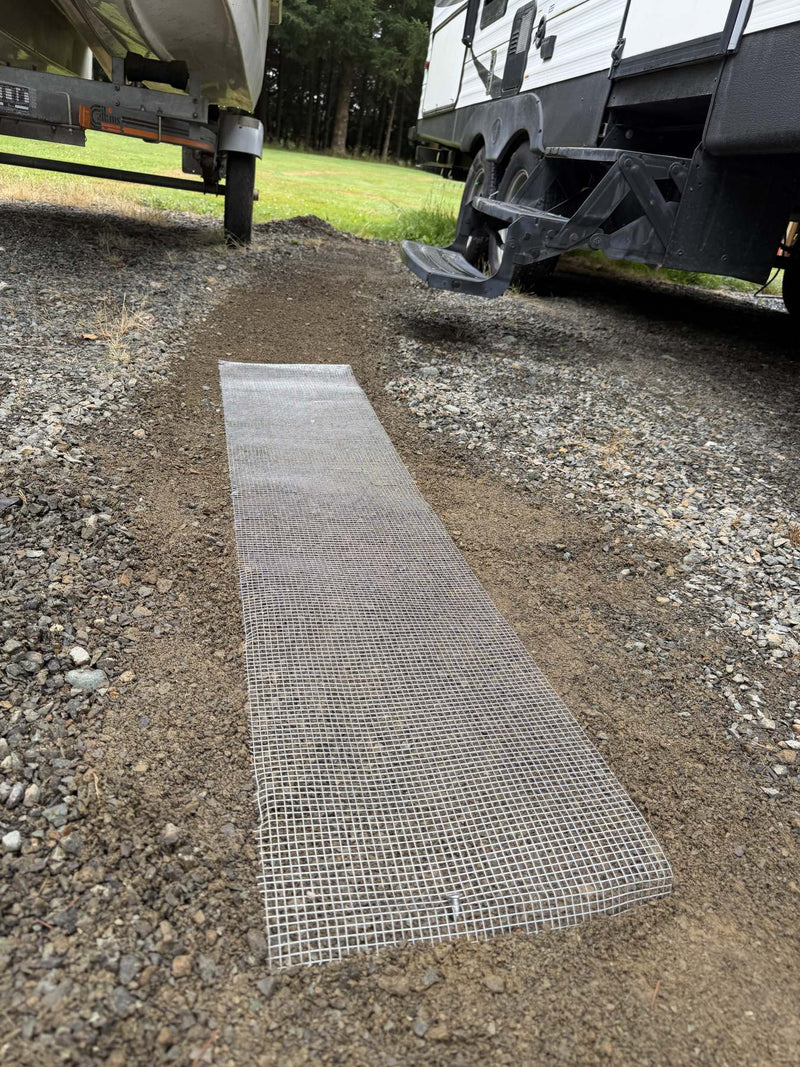
If you're setting up on gravel or dirt, plan on a layer of galvanized metal mesh as part of your setup. Loose ground gives mice a way to burrow beneath the barrier, and the mesh closes that path. We recommend extending the mesh 6 to 12 inches beyond the outside perimeter of the Box-Kat. It can be staked down and lightly covered with gravel or dirt to help keep it in place.
Brace for wind & weather
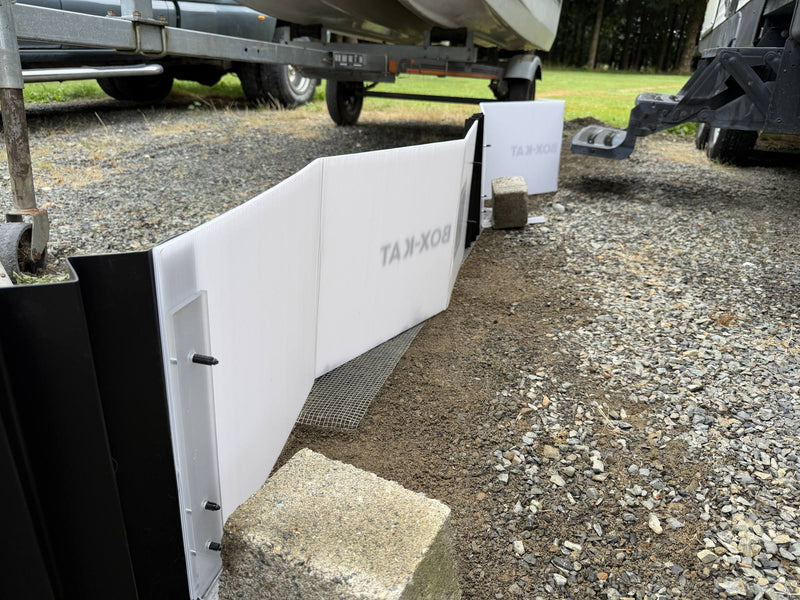
Wind and weather can cause the barrier to shift if it isn't properly secured. To help keep it in place, we recommend using anchor weights such as gallon water bottles, sandbags, or cement blocks. Set them down gently on the inside half of the L-shaped support braces. The acrylic braces are sturdy, but a dropped cement block can crack them. If you're parked on soil or gravel, garden stakes over the braces are also a great option. After strong wind or storms, it's a good idea to check the barrier and make sure everything is still sitting securely.
Tips for daily drivers
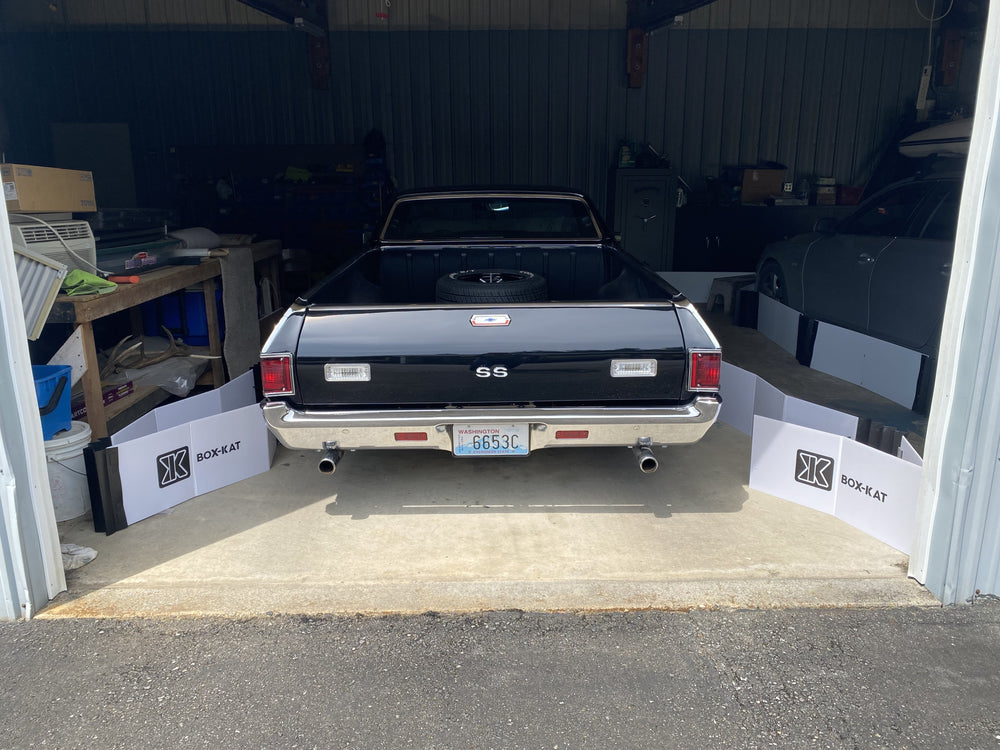
Each Box-Kat kit includes one set of wing-nut screws for customers who use their vehicle regularly. During assembly, install them at one of the panel connection points instead of the standard push-in fender clips.
This creates a simple access point that can be opened and closed without tools, making it easy to move your vehicle in and out of the barrier. When you return, just re-tighten the wing nuts to put the barrier back in place.
The same wing-nut screws are the right choice anywhere you expect to open the barrier regularly. The push-in fender clips make a strong connection that's meant to stay in place for the season, and they're difficult to remove and reinstall over and over. If you plan to assemble and disassemble your kit often, substitute wing-nut screws for the fender clips at the connection points you'll open. They're inexpensive and available at any hardware store.
Frequently asked questions
Do I need a perfect surface for the Box-Kat to work?
Not at all. The Box-Kat's flex panels are designed to adapt to imperfect surfaces. That said, a little prep can go a long way towards maximizing the barrier's effectiveness.
Can I use the Box-Kat on gravel or dirt?
Yes, with some extra preparation. Plan on raking the area to remove large clumps and sudden dips, laying galvanized mesh around the perimeter to discourage burrowing, and staking the braces where needed. The flex connectors help the barrier adjust to what's left, and anchor weights keep it stable. It's a bit more work than a garage floor, but a gravel setup done this way works well.
How do you anchor the Box-Kat in outdoor setups?
For outdoor setups, we strongly recommend using some type of anchoring or added support. Wind and weather can cause the barrier to shift if it is not properly secured.
Many customers use gallon water bottles, sandbags, or cement blocks placed on the inner L-shaped support braces. The goal is to add stability without damaging the braces. If you are using heavier materials, place them carefully rather than dropping them onto the acrylic supports.
What should I do if my parking surface is uneven?
The Box-Kat is built with flexible panels that help it conform to uneven ground, but surface prep still matters.
- Try to make the area as smooth and gradual as possible before setting up.
- On gravel or dirt, rake away large clumps, fill sudden dips when possible, and aim for a surface that allows the panels to sit more evenly.
- Place the Box-Kat's black flex connectors over the largest shifts in slope so they can follow the ground.
If your parking area has severe changes in elevation, large cracks, or drop-offs, the Box-Kat may have more difficulty. You can always reach out to us at hello@box-kat.com to ask about your specific setup situation.
Can mice burrow underneath the Box-Kat?
On loose gravel or dirt, burrowing can be more of a concern than on solid surfaces. For added protection, some customers choose to install galvanized mesh underneath or around the outside perimeter of the barrier. Extending the mesh 6 to 12 inches beyond the edge of the Box-Kat can help discourage burrowing underneath.
Can I still use the Box-Kat if I drive my vehicle regularly?
Of course. Each kit includes a set of wing-nut screws that can be installed at one of the panel connection points to create a quick-access opening. This makes it easier to move the panels aside when you need to drive and secure them again when the vehicle is parked.
Is outdoor setup harder than indoor setup?
Indoor setups are usually simpler because the surface is more stable and protected from weather. Outdoor setups may require a little more preparation, especially on gravel, dirt, or in exposed areas, but with the right surface prep and support, they can still work very well.
Does the Box-Kat have to be set up as a perfect rectangle?
No. The dimensions we list describe the general shape and fit. The barrier can just as easily be set up in an oval-like shape, borrowing a few inches from the length to add to the width, as long as the perimeter stays closed. Use the flex connectors to make the turns. We don't recommend reverse-bending the panels or bending them along new lines to change the shape.
How do I store my Box-Kat when not in use?
The Box-Kat is designed for long-term setup. Its push-in fender clips hold securely over time, which also makes them difficult to remove and reinstall repeatedly. For seasonal storage, most customers remove the clips at a few connection points, leave the panels partially assembled in 5-foot sections, and stack them flat. If you'd like to take your kit apart often, substitute wing-nut screws for the fender clips at the connection points you'll open, the same way our daily-driver access point works.
Stuck on something?
Send a photo of your setup to hello@box-kat.com and we'll tell you what we'd do.